

~ A DriveWays Review ~
by Matthew Aukofer
Ford has announced it will cut F-150 Lightning production in half this year, from 3,200 units per week to 1,600 units, due to less anticipated demand and profits. Ford also is delaying some of its other EV investments and battery plants, as it expects global EV adoption to be slower than expected.
Ford sold 24,000 units of the F-150 Lightning in 2023, just a fraction of the 750,000 gas-powered F-150s sold. The company is facing increased competition from other electric truck makers, such as Tesla, Rivian and GMC, ongoing supply-chain issues and a customer base that appears less interested in the shift to EVs than originally thought.
Ford will still focus on its other EV models, such as the Mustang Mach-E and the E-Transit, which have lower costs and higher profit margins than the F-150 Lightning.
But if you’re in the market for a full-size all-electric pickup truck, the Lightning is hard to beat. It’s the first all-electric version of America’s best-selling pickup truck. It is a pricey but impressive package. It offers exhilarating performance, innovative features and a familiar design that appeals to loyal F-150 fans and new buyers alike. Other than its almost silent running nature, the Lightning drives and feels like a gas-powered F-150—familiar terrain for a host of truck lovers.
Even with the cut in production numbers, Ford isn’t abandoning the Lightning. It plans adjustments to the Lightning’s pricing and trim packages. For the 2024 model year, Ford will add a new Flash trim that offers more range and features. Ford’s also showcasing a new F-150 Lightning Switchgear concept that pushes the boundaries of what’s expected from EV trucks, with enhanced off-road capabilities and performance.
The F-150 Lightning is a blast to drive, thanks to its instant and abundant torque that propels it from zero to 60 mph in just four seconds with the extended-range battery pack. The dual electric motors, which provide 580 horsepower and 775 pound-feet of torque, or twisting force, in the tested vehicle, provide smooth and quiet acceleration, as well as regenerative braking that can extend the range.
The Lightning handles well for a large and heavy truck, with responsive steering and minimal body roll. It also has a selectable drive mode system that adjusts the powertrain, steering, suspension, and traction settings to suit different driving scenarios, such as Sport, Tow/Haul, Off-Road and Slippery.


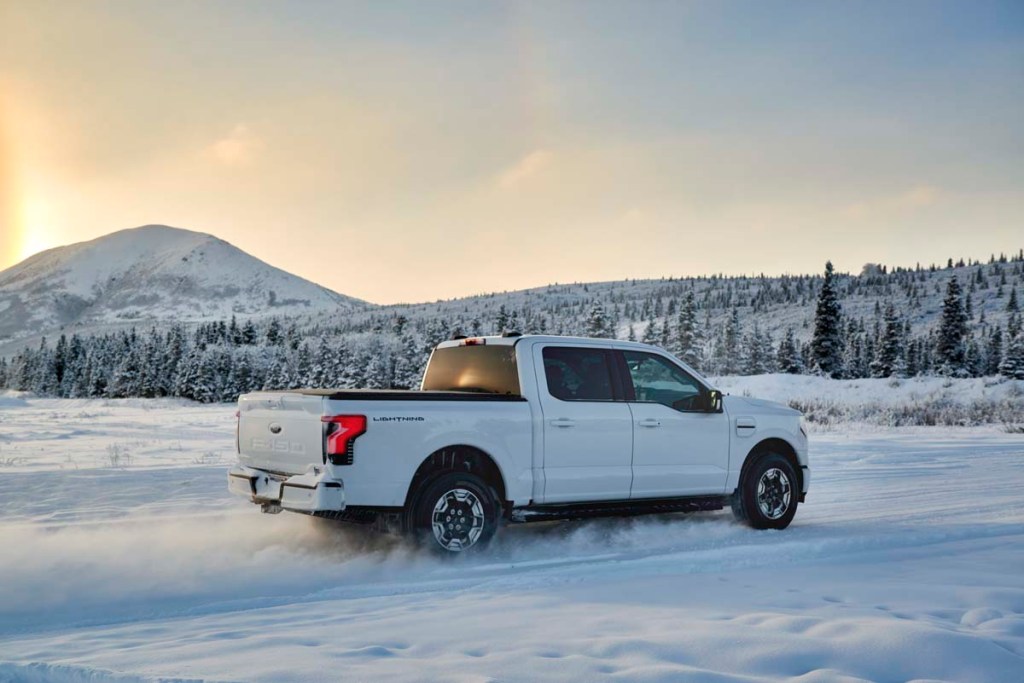
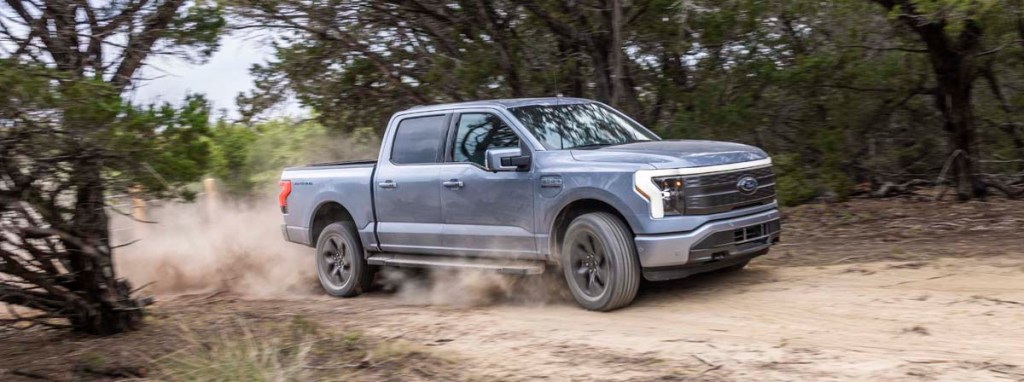
Just like its gas-powered brethren, the Lightning is also capable of towing and hauling, with a maximum towing capacity of 10,000 pounds and a maximum payload capacity of 2,000 pounds with the extended-range battery pack. However, towing and hauling will significantly reduce the range, so drivers will need to plan ahead and use the available towing and range calculators to estimate the impact. The F-150 Lightning also has a unique feature that sets it apart from other trucks: a massive front trunk, or frunk, that can hold up to 400 pounds of cargo and has a drainable floor that can double as a cooler.
The best part about the Lightning is it drives like a gas-powered F-150, only without the thrum of pistons throbbing under the hood. It is extremely quiet and capable, both around town and on the highway. The Lightning has a fully independent suspension, which improves the ride quality and handling, but also reduces the ground clearance slightly compared to the gas version. Its ride isn’t overly harsh or bouncy, even when unladen—a common problem for heavy haulers. It’s not Lexus-smooth, but it’s poised in its handling. It’s not going to jar the molars out of the back of your jaw.
The black interior on the tested model—the top-of-the-line Platinum Series—is nicely appointed. Its 10-way power adjustable black leather seats, which are heated and ventilated, featured cream-colored accents and handsome stitching, which matched the stitching on the door panels, the dashboard and center console. Ford also uses other contrasting materials to give the cabin a more polished look and feel. The smooth leather is accented with suede inserts in various places, for example, to break up the textures and make things more visually appealing.
Of course, being a full-size truck, it is very roomy, especially the rear seat. The rear is positively cavernous with plenty of legroom and headroom for even the largest riders. The spaciousness is even more pronounced when the twin-panel moonroof that came equipped on the tested truck is open to the sky. The fit and finish was pretty good, although the speaker grill that occupied the top center of the dashboard had already seem to warp, which was disconcerting on a vehicle with less than 10,000 miles on the clock.
As with other Fords and Lincolns—and many other vehicles today, for that matter—there aren’t a lot of tactile knobs, buttons and switches to perform common functions, like adjusting the radio or climate-control system. Almost everything is done by tapping the infotainment touchscreen, which can be frustrating to use. Lots of screen real estate is taken up with graphics instead of short-cut controls. The emphasis seems to be on beauty over function.
For example, the climate control system has no traditional knobs, buttons or switches. All adjustments must be done by tapping the screen. The climate controls occupy a set of soft buttons the lower part of the infotainment screen, but there is no button here to turn on air recirculation, for example. You must menu dive for that.
Ford did include traditional knobs and buttons for the headlights, but they placed them low on the dashboard to the left of the steering wheel at knee height, making them difficult to see or adjust, especially while driving.


Outside, the Lightning closely resembles other F-150s. The big difference is the distinctive light bar that spans the front grille and connects the LED headlights, creating a signature look that is both modern and aggressive. The grille itself is mostly closed, as the electric powertrain does not need as much air intake as a combustion engine. The rear of the Lightning also sports a light bar that connects the taillights, echoing the front design and adding a touch of sophistication. The tailgate on the 5’ 7” bed has a power function and a built-in step, as well as multiple outlets and hooks for convenience.
The Lightning’s towing capability depends on the battery type and the optional packages. The Lightning has a maximum towing capacity of 10,000 pounds with the extended-range battery and the Max Trailer Tow package. This package is available for the XLT and Lariat trims, and it adds more cooling capacity for the battery and motors. The Platinum trim, reviewed here, comes standard with the extended-range battery and can tow up to 8,500 pounds with the same package. Without the Max Trailer Tow package, the extended-range battery models have a towing capacity of 7,700 pounds. The standard-range battery models also have a towing capacity of 7,700 pounds with the Max Trailer Tow package, and 5,000 pounds without it. The Pro trim, which is the base model, only comes with the standard-range battery and does not offer the Max Trailer Tow package.
As with almost any EV on the market today, the range meter was not always accurate. The distance to empty varies with a host of conditions, so it takes some getting used to when compared to a traditional gas gauge. If you drive hard and fast, your range will go down more quickly than your actual miles driven. If you crank the heat or air conditioning, use the heated seats and crank the stereo system, your range will suffer. Cold weather can also cause the range gauge to drop more precipitously.
On a particularly cold day, we noticed the Lightning used up 10 miles of range over a four-mile trip. We were running the heat, the seat heaters, the steering wheel warmer and the radio, which probably ate up most of the range we lost. But then that evening, which was also cold, we noticed that the Lightning lost several miles of range just sitting unoccupied overnight.
EV owners might confess that it requires more planning and foresight than you might be used to. For some new buyers, the switch to EVs might require a complete lifestyle change if you drive a lot and have to constantly calculate trip distances, break times and recharging locations. It’s what is commonly referred to as range anxiety, and it could be a large reason why the EV market in general is not growing as quickly as once thought, and why Ford was forced to cut Lightning production in half.
The development of EVs has happened quickly and the charging infrastructure has struggled to keep pace. To borrow an old idiom, someone may have put the cart before the horse.
Trim Levels
The F-150 Lightning comes in four trim levels: Pro, XLT, Lariat, and Platinum. All models have a four-door crew cab, a 5.5-foot bed, dual electric motors for four-wheel drive, and a single-speed transmission.
The Pro is the base model, starting at $51,990, and is aimed at commercial and fleet customers. It has a standard-range battery (98 kWh) battery pack that produces 452 horsepower and 775 lb-ft of torque, and delivers an EPA-estimated range of 230 miles. It also comes with a 12-inch touchscreen with Ford’s SYNC 4 infotainment system, a 12-inch digital gauge cluster, a power tailgate, and a host of driver-assist features.
The XLT is the next step up, starting at $57,990, and adds more comfort and convenience features, such as cloth seats, a leather-wrapped steering wheel, heated mirrors, LED headlights and taillights, blind-spot monitoring, and a 360-degree camera. The XLT also offers an optional extended-range battery pack (131 kWh) that boosts the output to 580 horsepower and increases the range to 320 miles. The extended-range battery pack also includes a faster home charger and a Pro Power Onboard system that can supply up to 9.6 kW of electricity to power tools, appliances, or a house.
The Lariat is the luxury-oriented trim, starting at $69,990, and adds leather seats, a heated steering wheel, a power tilt-and-telescoping steering column, a Bang & Olufsen sound system, a wireless charging pad, and a 15.5-inch touchscreen with SYNC 4A. The Lariat also has the option of the extended-range battery pack and the Pro Power Onboard system, as well as a panoramic sunroof, power-actuated running boards, and a trailer tow package.
The Platinum is the top-of-the-line trim, starting at $93,990, and comes standard with the extended-range battery pack and the Pro Power Onboard system. It also adds exclusive features, such as massaging front seats, a wood-trimmed interior, adaptive cruise control, active park assist, and a BlueCruise hands-free driving system.
The F-150 Lightning’s top speed is limited to 111.8 mph, regardless of the trim or battery type.
Competition
The F-150 Lightning faces some tough competition from other electric trucks, such as the GMC Hummer EV SUT, the Rivian R1T, and the Tesla Cybertruck. The Hummer EV SUT is the most expensive and extravagant of the bunch, starting at $112,595, and offers a range of 350 miles, a power output of 1,000 horsepower, and a host of off-road features, such as CrabWalk and Extract Mode.
The Rivian R1T is the most adventurous and versatile, starting at $67,500, and offering a range of 314 miles, a power output of 754 horsepower, and a unique gear tunnel that can store various accessories, such as a camp kitchen.
The Tesla Cybertruck is the most futuristic and controversial, starting at $49,900, and offering a range of up to 500 miles, a power output of up to 800 horsepower, and a distinctive stainless steel body.
There are also some upcoming electric trucks that are expected to debut in 2024, such as the Chevrolet Silverado EV2, the GMC Sierra EV3, and the Ram 1500 Rev and Ram 1500 Ramcharger. These trucks will likely compete with the Ford F-150 Lightning in terms of performance, efficiency, and features.
The F-150 Lightning is the most conventional and practical of the currently available electric trucks, and that could be its biggest strength or weakness, depending on the buyer’s preference.
For those who want a truck that looks and feels like a regular F-150, but with the benefits of electric power, the F-150 Lightning is a no-brainer. For those who want a truck that stands out and offers more features and capabilities, the F-150 Lightning might seem too bland and conservative.
Either way, the F-150 Lightning is a remarkable achievement for Ford and a game-changer for the truck market. It is a worthy contender for anyone looking for an electric truck that can do it all.
Power and More Power
The 2023 Ford F-150 Lightning has a total of 11 power outlets distributed in different locations of the vehicle:
- Two 120V outlets in the cab
- Four 120V outlets and two USB outlets in the front trunk (also known as the Mega Power Frunk)
- Four 120V outlets and one 240V outlet in the bed
These outlets can be used to power various devices and appliances, such as laptops, tools, lights, coolers, and even TVs.
The F-150 Lightning also has the capability of providing Intelligent Backup Power to your home in case of a power outage, using the Home Integration System. Intelligent Backup Power allows the Lightning to send electricity back to a house through its charging cable, using a special device called the Home Integration System. The Home Integration System is a smart inverter that can automatically switch your home over to truck power when the electrical grid goes down.
According to Ford, a fully charged F-150 Lightning with the extended-range battery pack can power your entire house for up to three days. If you’re careful with your power consumption, Ford estimates it’ll power your home for up to 11 days. Once the power comes back on, the system will switch back and immediately begin recharging the truck.
The Lightning is the first electric truck to offer this capability, and it could be very useful in case of emergencies or natural disasters. However, the cost of installing the Home Integration System is not cheap, and it may require some upgrades to your home’s electrical panel.
The Home Integration System is sold exclusively by Sunrun, Ford’s partner and rooftop solar supplier. According to Ford’s Director of Charging & Energy Services, Matthew Stover, the system will cost $3,895. However, this does not include the installation cost, which may vary depending on your home’s electrical setup. Some customers have reported installation costs ranging from $12,000 to $18,000. You may also need to upgrade your electrical panel, which could add to the expense. The Home Integration System is compatible with the Ford Charge Station Pro, which comes standard with the extended-range battery pack, or can be purchased separately for $1,310. If you are interested in getting a quote and more information about the Home Integration System, you can contact Sunrun through their website.
Specifications
- Model: 2023 Ford F-150 Lightning 4×4 Crew Cab, Platinum Series
- Engine: Dual electric motors, all-wheel drive. The motors produce 580 horsepower and 775 pound-feet of torque with the extended range battery. The extended range battery is a 131-kWh pack that provides up to 320 miles of range.
- Transmission: Single-speed automatic.
- Overall length: 19 feet 5 inches.
- Height: 6 feet 6 inches.
- Passenger volume: 131.8 cubic feet.
- Cargo volume: 52.8 cubic feet in the bed.
- Front trunk volume: 14.1 cubic feet.
- Bed length: 5 feet, 7 inches.
- Weight: 6,893 pounds.
- Towing capability: 8,600 pounds.
- EPA city/highway/combined fuel consumption: 73/60/66 miles per gallon of gasoline equivalent (MPGe); 51 kW-hrs. per 100 miles.
- Base price: $95,579.
- Price as tested, including destination charge: $97,374.
Disclaimer: The manufacturer provided the vehicle used to conduct this test drive and review. Photos ©Ford
 Frank A. Aukofer
 Jason Fogelson
 Matthew P. Aukofer
 Tod Mesirow
 The Review Garage
Leave a comment