
~ A DriveWays Review ~
by Frank A. Aukofer
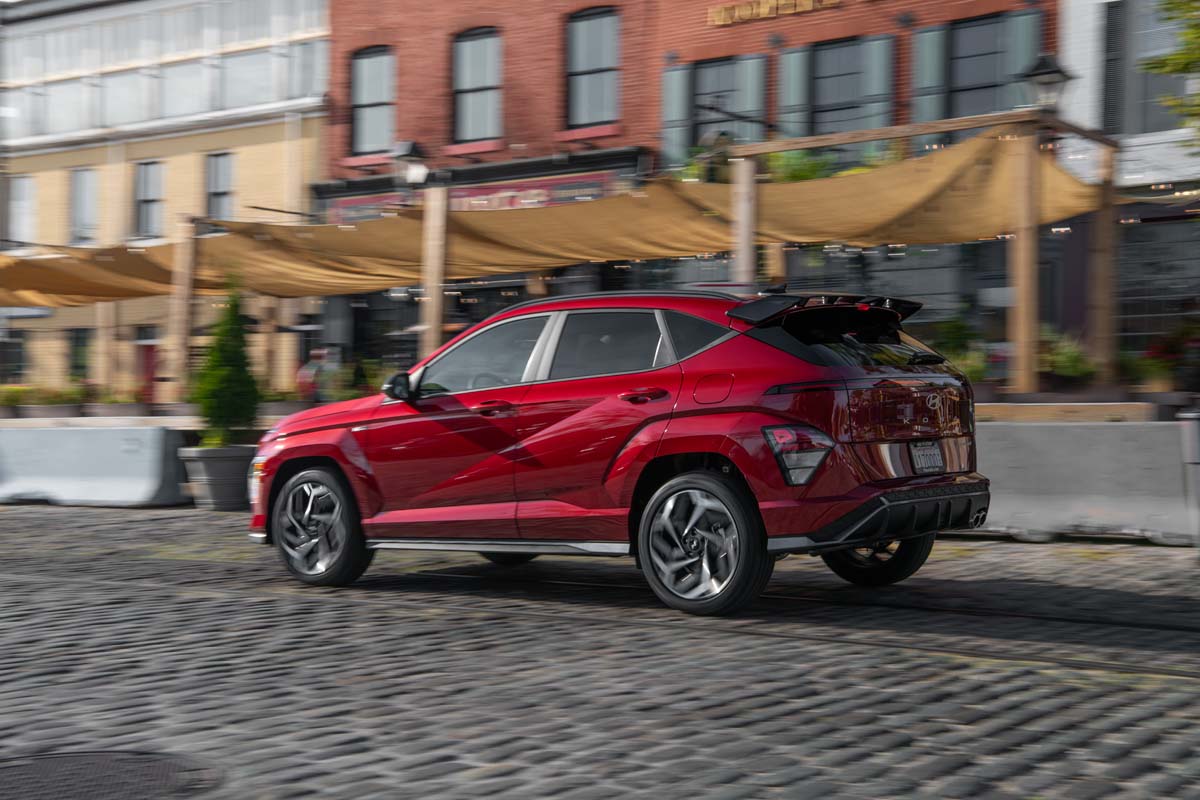
In human terms, the 2024 Hyundai Kona N Line crossover sport utility vehicle is still in grade school. Introduced in the U.S. in 2017 in (no surprise) Kona, Hawaii, the seven-year-old is listed as “small” by the Environmental Protection Agency but is popularly categorized as a subcompact SUV.
That doesn’t do it justice. The EPA classifies automobiles according to their interior volume, which includes passenger and cargo space. Its biggest category is “large,” which covers any car with an interior space of 120 cubic feet or more.
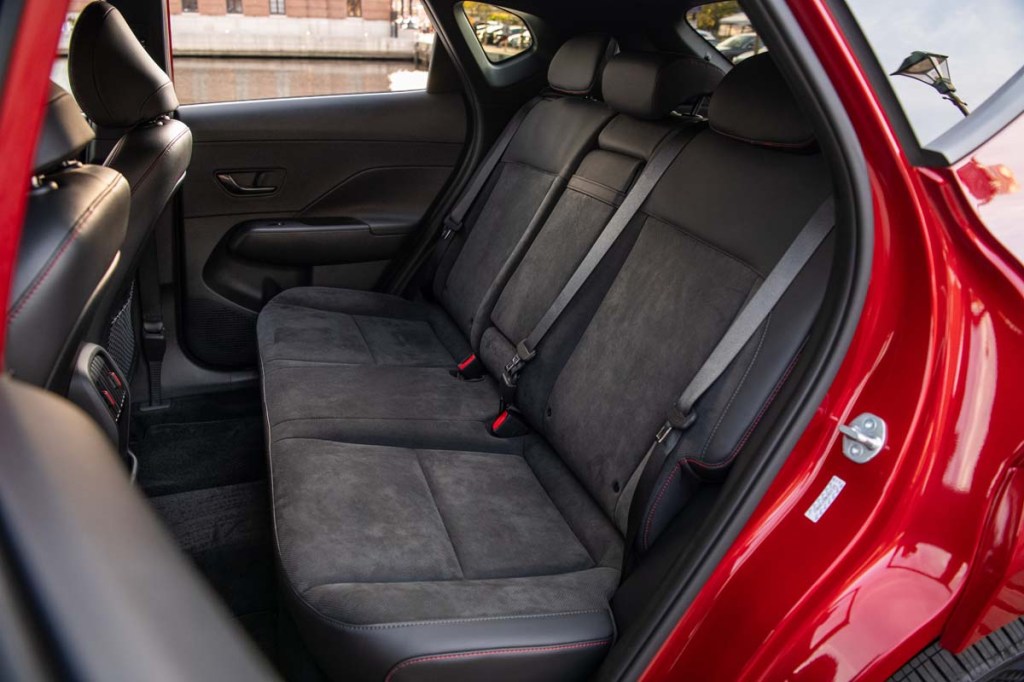
The new Kona N Line handily beats that with 108 cubic feet of room for five passengers and 26 cubic feet of cargo space behind the second-row seat. The total of 134 cubic feet places it in the “large” car category—except for the fact that the EPA stubbornly rates SUVs as either “small” or “standard” without naming the criteria.
The gigantic Jeep Grand Wagoneer and Chevrolet Suburban both are rated as “standard” SUVs, while the Ford Escape escapes with a “small” designation. That leaves critics like this one the leeway to make up their own classifications.
So we can simply leave the Hyundai Kona N Line with its “small” designation, though with the understanding that it actually has more space inside for people and luggage than the Rolls-Royce Phantom.
At Hyundai, the “N” moniker denotes a model with higher performance than the typical version, not unlike BMW with its “M” models, Mercedes-Benz with its “AMG” spinoffs and Cadillac’s “V” hotshots.
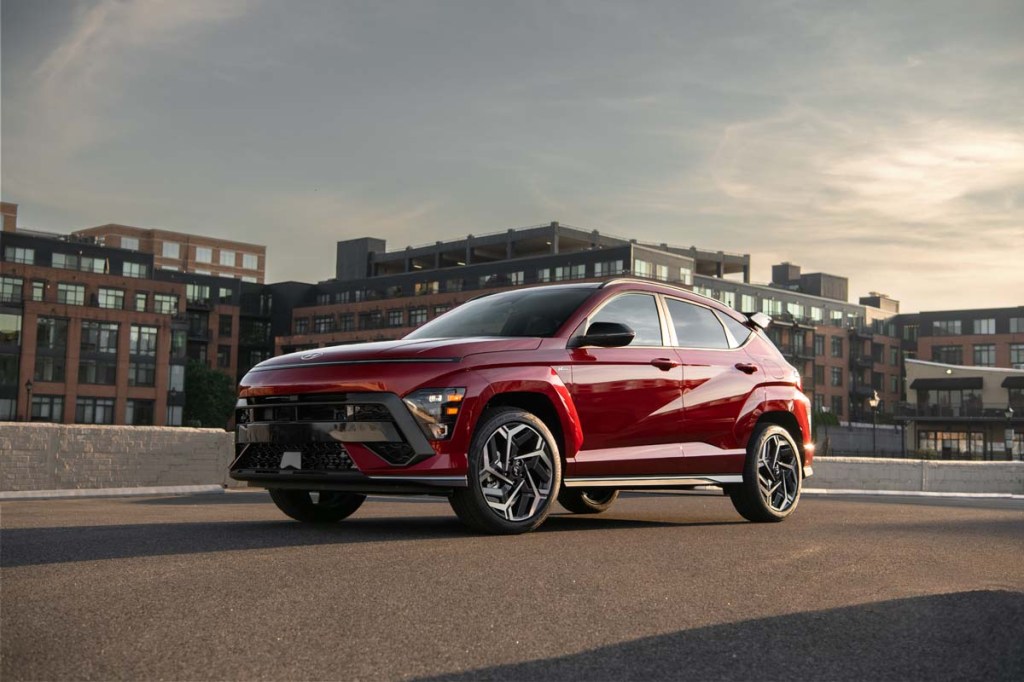
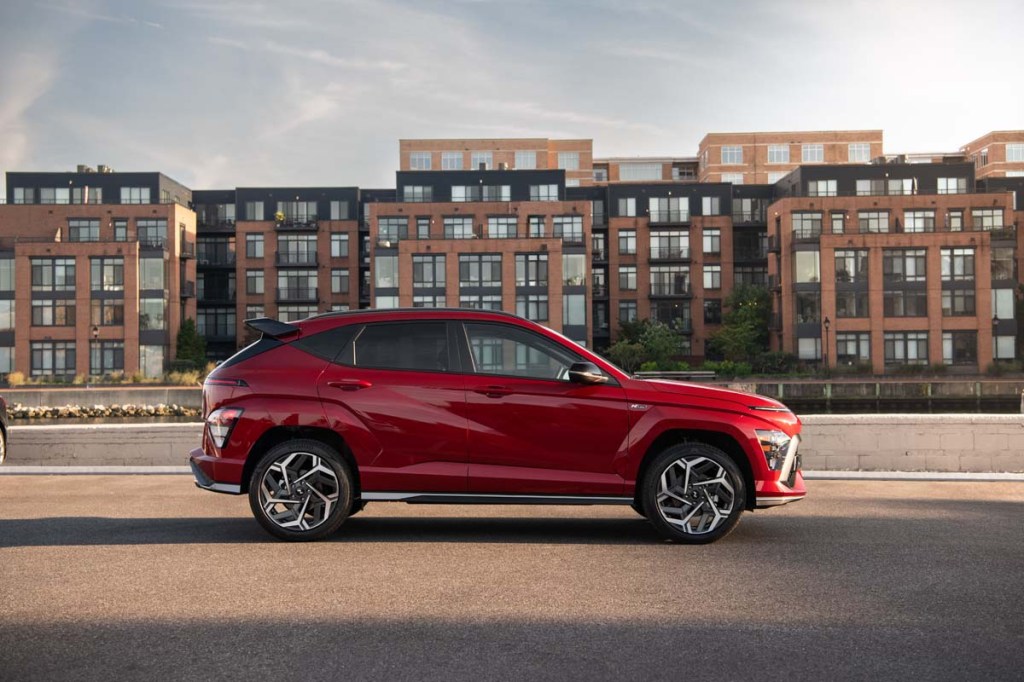
The Hyundai Kona is all-new for 2024, with rugged new styling that foreshadows a day—not far in the future—when electric cars will be commonplace on America’s streets and highways. From the front the tested N Line model resembles an electric car, with seemingly few intakes for air to cool a gasoline engine.
It’s an illusion but gives the Kona a bold personality all its own. Though Hyundai makes a decent, not too expensive electric Kona, the gasoline powered model N Line has many of the virtues expected by the motoring public.
On the 2024 Kona, this 1.6-liter ICE (for internal combustion engine) is turbocharged to make 190 horsepower and 195 pound-feet of torque, or twisting force. It’s enough to propel the boxy crossover to 60 miles an hour in the seven-second range—not outstanding in this era but acceptable.
Sending the power through an eight-speed automatic transmission to all four wheels combines with a flexible suspension system to deliver frisky handling on curving roads. Paddles mounted on the steering wheel enable manual shifting control.
At the same time, the Kona delivers a reasonably comfortable ride on all but the roughest surfaces, as well as mostly silent running on Interstate highways with wind, road and tire noise mostly absent. It’s a comfy long-distance cruiser.
There was no opportunity to test the Kona’s off-road chops. With its modern all-wheel drive, it has boondocks bashing capabilities. But its forte is hauling people and cargo on paved roads in good and challenging weather.
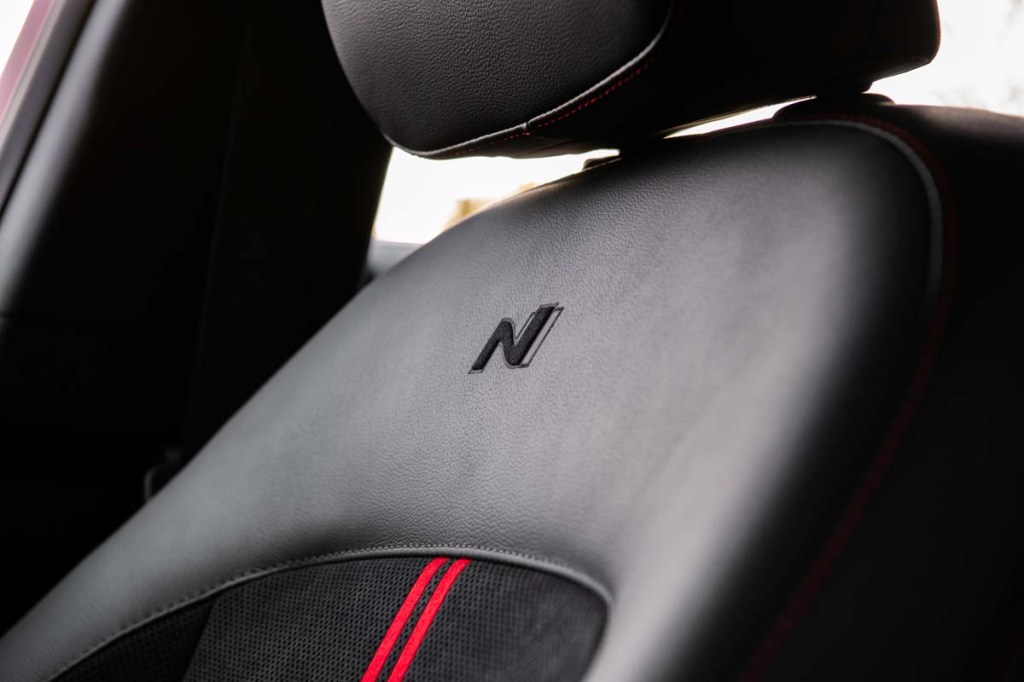
Comfort is enhanced by supportive and comfortable front seats with good seatback bolstering, as well as heated and perforated cloth upholstery that grips the torso during aggressive driving.


The 2024 Kona SE comes with a starting price of $25,545, including the destination charge. There are three other trim levels, including the tested N Line, which started at $33,485 and, with a few minor options, had a suggested sticker price of $33,695.
That included a full suite of safety enhancements, including forward collision avoidance, lane-keeping and following assist, blind-spot monitoring, driver attention warning, rear cross-traffic collision avoidance, rear-view camera, safe-exit warning, heated outside mirrors, and adaptive cruise control.
Other equipment included dual-zone automatic climate control, a navigation system, Android Auto and Apple Car Play, Bose premium audio, SXM satellite radio, Bluelink connected services, Wi-Fi hotspot and a wireless smart phone charger.
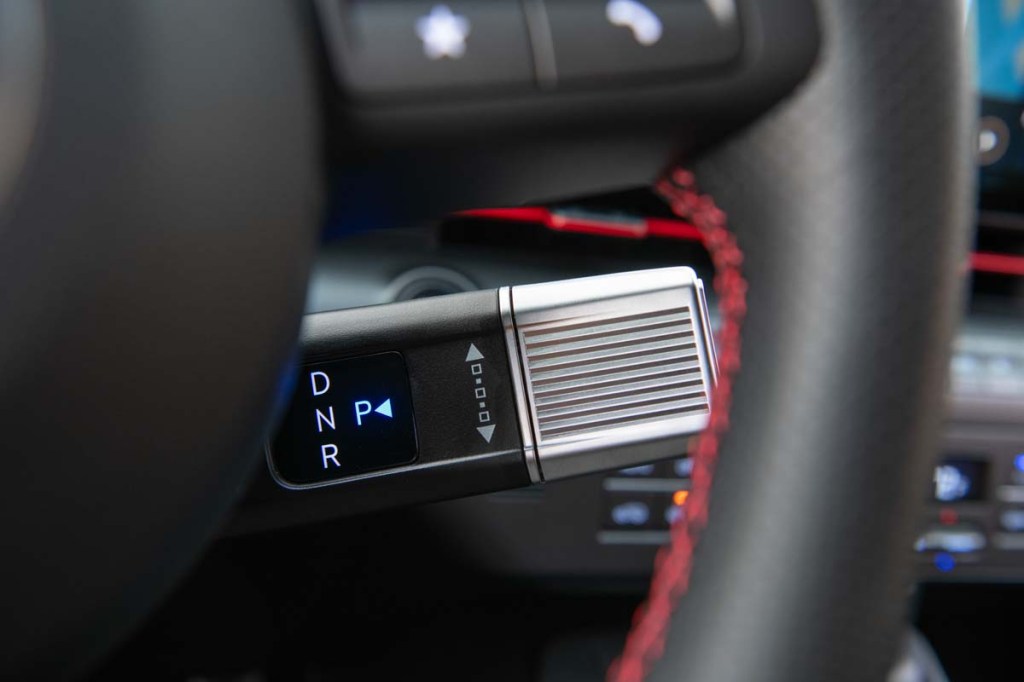
Hyundai has redesigned the Kona’s shifter, which now incorporates a twister on a steering column shaft. Twist forward for “drive,” backward for “reverse” and the touch of a button for “park.” It opens up extra storage space underneath the center console.
There is one oddity. In the instrument cluster are two circular gauges, ostensibly for the speedometer and tachometer. Neither displays the gauge; they simply show digital numbers for the rpms and speed. A Hyundai spokesperson said the unusual setup was simply a design decision.
Specifications
- Model: 2024 Hyundai Kona N Line AWD four-door crossover sport utility vehicle.
- Engine: 1.6-liter four-cylinder, turbocharged; 190 hp, 195 lb-ft torque.
- Transmission: Eight-speed automatic with manual shift mode and all-wheel drive.
- Overall length: 14 feet 5 inches.
- Height: 5 feet 4 inches.
- EPA/SAE passenger/cargo volume: 108/26 cubic feet.
- Weight: 3,480 pounds.
- Towing capability: 3,500 pounds.
- EPA city/highway/combined fuel consumption: 24/29/26 mpg. Range: 343 miles.
- Base price, including destination charge: $33,485. Price as tested: $33,695.
Disclaimer: The manufacturer provided the vehicle used to conduct this test drive and review. Photos ©Hyundai
 Frank A. Aukofer
 Jason Fogelson
 Matthew P. Aukofer
 Tod Mesirow
 The Review Garage
Leave a comment